I've sold clothes in Ecuador since 2019 with Cosaco, a small brand of fleece hoodies, robes and blankets. Like most shops here, almost every sale happens in a WhatsApp chat. Someone sees an ad, writes "how much?", asks about sizes, and sends a photo of their bank transfer.
For years that chat was me, and the hard part was the hours. More than 4 in 10 new customers write between 7 at night and 8 in the morning. In April 2026 I wrote a first bot on Google Apps Script so they would get an answer. It was rough. It got totals wrong and forgot what people had just said. But people bought from it.
So I kept going. I rebuilt it from scratch on Cloudflare with OpenAI models, added Instagram and Facebook, and turned it into Qezi. Today it sells for two clothing brands and a spa with locations in several cities, and I still read their conversations every week. Since April I've written about 2,500 commits on Qezi, building it together with AI coding agents.
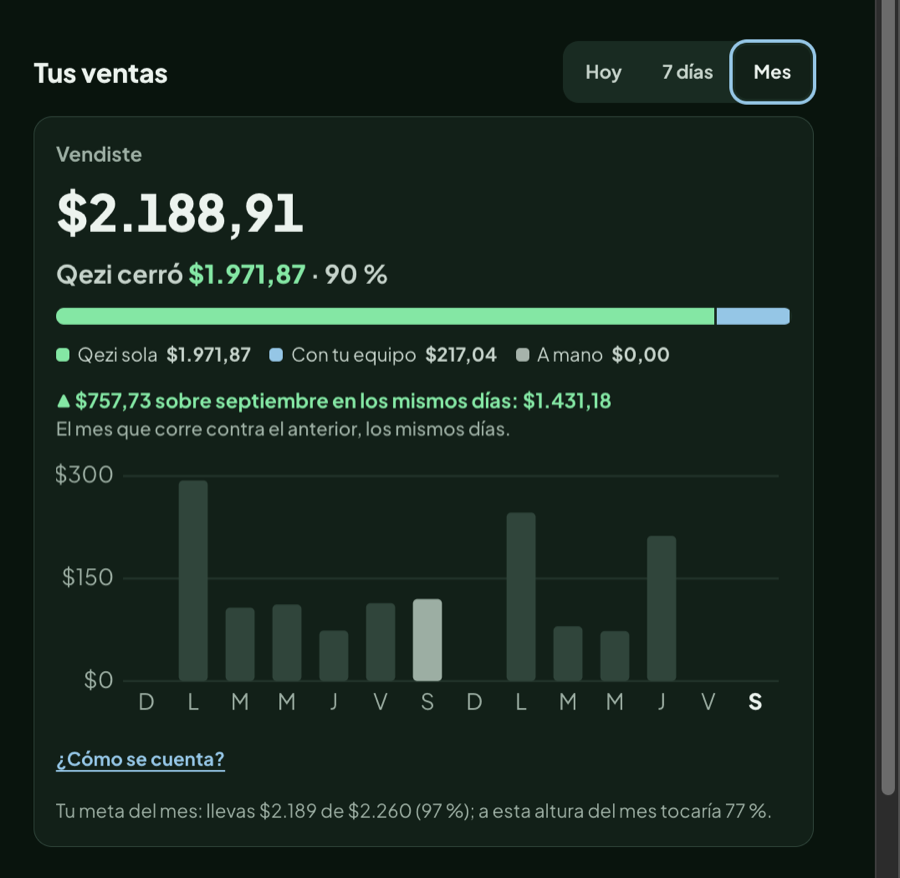
From the sales screen store owners see in Qezi, and from the conversation logs. Cosaco and Ánku are clothing brands in Ecuador.
A shop owner can't afford a bot that's wrong about a price. So every important choice gets tested on real conversations before it ships, and I write down what I find even when it proves me wrong.
The first bot made pricing mistakes. I moved prices, stock, discounts and totals into plain code and replayed 664 real conversations against it.
The model writes the message. Code decides every number.
Same prompt, same history, 200 real turns, two models side by side. Then the same for a newer, cheaper model, and for a premium one on hard objections.
Switched to the cheaper model with fewer errors. Skipped the premium one: no better, 18 times the cost.
I use an LLM to grade lost chats. Changing only the judge model moved the result from 14% to 32%.
One fixed judge for every comparison, and real customers decide the rest.
New ideas run as live A/B tests with real customers, checked with Fisher's exact test. A stronger welcome message won at p = 0.008. A one-step order flow looked 3 points better but wasn't significant (p = 0.15), so it stayed off.
Only measured wins go live.
A clothing store, a spa and a restaurant all sell in chat, but they ask different questions. Qezi has an agent for each kind of business. Simulated means tested against scripted customers, not live yet.
Sizes, colors, stock, shipping and payment, in the customer's own words. It reads photos customers send, like a screenshot of an ad, and understands voice notes. When it should, it hands the chat to a person in the same thread.
Answers and books appointments for a spa with several locations, on WhatsApp, Instagram and Facebook. Went live for Black Friday.
Owners ask about their sales in plain words. Code computes the figures, the model only explains them. 20 test questions, zero wrong numbers.
Class bookings, restaurant orders, quotes that a person approves. Simulated customers went from 2 of 32 handled to 30 of 32 for the gym, and 2 of 18 to 17 of 18 for the waiter.
A new business pastes its website and the AI drafts the store. In a real setup it cut the questions from 16 to 4.
First bot on Google Apps Script, answering Cosaco's WhatsApp. First AI product photos for the catalog.
First A/B tests on how to show the catalog and when to follow up. The bot learns to offer cash on delivery by itself.
Rebuilt on Cloudflare. The bot starts seeing photos and hearing voice notes. Owners get a sales screen and a shared inbox.
Qezi opens to other businesses: setup that reads your website, card payments with Payphone, agents for services and restaurants.
Meta approves Qezi's app permissions. A spa with locations in several cities goes live on WhatsApp, Instagram and Facebook, in time for Black Friday.
Small brands can't pay for a photo shoot every season, or a video team.

I'm also Head of Operations at a US consumer gaming startup, where I run acquisition, CRM and data. Since April 2026 I've built its whole data platform with AI coding agents: 760 commits, the warehouse, the models, the reports and the automations.
It's a different business from a clothing shop, but the lesson is the same: AI is most useful when it's wired into the numbers a business already runs on, and a person stays in charge of anything that spends money.
Early on the bot quoted wrong totals. Now prices, stock and discounts come from code, and the model only writes the message.
Before I set up a business I read its real conversations. How the owner already answers is a better spec than any form.
My most expensive bug was the bot not replying at all. Now a check runs every minute and picks up any message left without an answer.
The most useful results I've had were the ones that proved me wrong: a premium model that wasn't better, a promotion that didn't sell.
If that's what you're working on, I'd like to talk.
Email me